
The Simon Says game is a classic group activity that combines listening skills, quick reactions, and plenty of laughter. It is easy to organize, requires no special equipment, and works well at children’s birthday parties, family gatherings, school events, and other group celebrations. Players must listen carefully to the leader and follow instructions only when they begin with the words “Simon says.” One small mistake can catch even the most attentive players off guard!
Whether you are introducing children to the original Simon Says game or looking for creative variations to keep a party entertaining, this guide explains the rules, how to play, and several ways to make the activity more challenging.
What Is the Simon Says Game?
The Simon Says game is a traditional listening and action game in which one person takes the role of the leader, known as Simon. The leader gives instructions, and everyone else must decide whether to follow them.
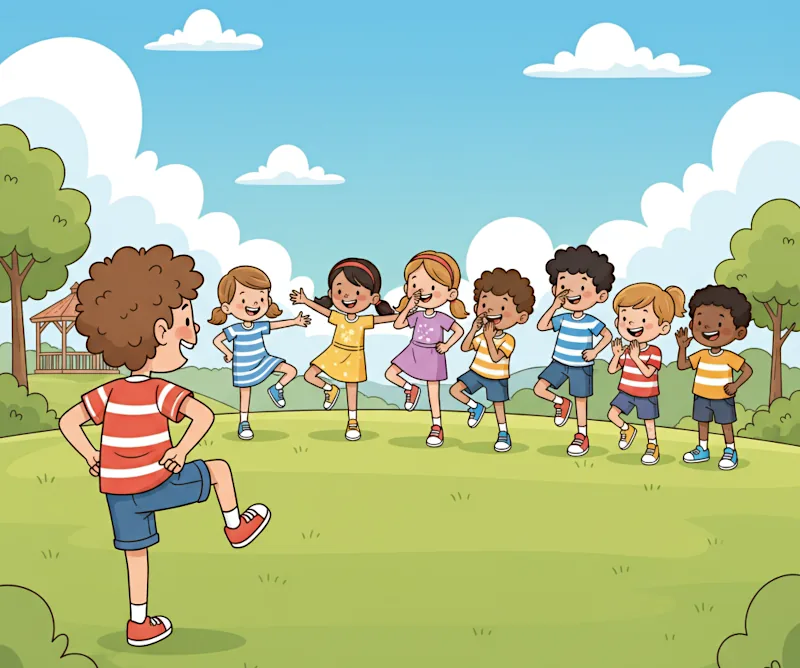
The important rule is that players should only perform an action when the instruction begins with “Simon says.” If the leader gives a command without using those words, players must remain still.
For example:
- “Simon says touch your nose.” Players must touch their noses.
- “Simon says clap your hands.” Players must clap.
- “Jump up and down.” Players must ignore the instruction because it does not begin with “Simon says.”
Anyone who follows an instruction without the required opening phrase makes a mistake. Depending on the version being played, that player may be eliminated or simply receive a point against them.
The game is popular because it is simple to understand but surprisingly difficult when the leader starts giving commands quickly. It encourages concentration, listening, coordination, and self-control.
How to Play Simon Says: Rules and Instructions
Learning how to play the Simon Says game takes only a few minutes. You do not need equipment, a playing area, or any preparation beyond choosing someone to lead.
Here are the basic instructions for organizing a game.
Step 1: Choose a Leader
Select one person to be Simon. This person is responsible for giving instructions and trying to catch the other players making mistakes.
For birthday parties, an adult can start as the leader to demonstrate how the game works. Once everyone understands the rules, children can take turns being Simon.
Step 2: Explain the Rules
Before starting, explain that players must only follow instructions that begin with “Simon says.”
Make sure everyone understands that an instruction without these words must be ignored, even if it sounds like an ordinary command.
For example:
- “Simon says raise your right hand.” Everyone raises their right hand.
- “Touch your toes.” Everyone should stay still.
- “Simon says turn around.” Everyone turns around.
Step 3: Start Giving Commands
The leader gives a series of instructions, mixing commands that begin with “Simon says” with commands that do not.
Start slowly so younger children have time to understand the game. As players become more confident, increase the speed and introduce more surprising instructions.
Step 4: Identify Players Who Make Mistakes
In the traditional elimination version, anyone who follows an instruction without hearing “Simon says” is out.
Players can also be eliminated if they fail to perform a valid instruction or perform the wrong action.
For younger children, however, it is often better to avoid elimination. Instead, give a friendly reminder and allow everyone to continue playing.
Step 5: Decide Who Wins
Continue until only one player remains. That person is the winner and can become Simon for the next round.
For a birthday party with many children, consider playing several short rounds so different players have an opportunity to lead.
Basic Simon Says Game Rules at a Glance
These simple rules make the Simon Says game suitable for both small groups and large parties.
| Rule | What Players Must Do |
|---|---|
| Valid instruction | Follow commands beginning with “Simon says.” |
| Invalid instruction | Ignore commands without the opening phrase. |
| Incorrect action | The leader decides whether the player is eliminated or receives a penalty. |
| Winning | Be the last remaining player in elimination mode. |
| New round | Choose a new leader and start again. |
Original Simon Says Game Commands to Try
One of the easiest ways to keep the original Simon Says game interesting is to prepare a variety of commands before starting.
Use a mixture of simple movements, funny actions, and slightly more challenging instructions. The commands should be appropriate for the players’ ages and physical abilities.
Here are some examples to get started.
Easy Simon Says Game Commands
These instructions are suitable for younger children and beginners:
- Simon says touch your nose.
- Simon says clap your hands.
- Simon says close your eyes.
- Simon says raise both arms.
- Simon says touch your toes.
- Simon says smile.
- Simon says wiggle your fingers.
- Simon says stand on one foot.
- Simon says nod your head.
- Simon says turn around.
Funny Simon Says Commands
Funny actions are particularly effective at birthday parties because they get everyone laughing.
- Simon says pretend to be a chicken.
- Simon says make a funny face.
- Simon says walk like a penguin.
- Simon says pretend to brush your teeth.
- Simon says dance like a robot.
- Simon says roar like a lion.
- Simon says pretend to be a sleepy bear.
- Simon says act like a monkey.
- Simon says pretend to eat a giant sandwich.
- Simon says walk like a dinosaur.
Challenging Simon Says Commands
For older children and adults, introduce instructions that require more concentration and coordination.
- Simon says touch your left ear with your right hand.
- Simon says balance on one foot and close your eyes.
- Simon says clap twice and then touch your shoulders.
- Simon says turn around and raise both hands.
- Simon says touch your right knee with your left hand.
- Simon says take three steps backward.
- Simon says count to five while standing on one foot.
- Simon says tap your head while rubbing your stomach.
Mix these valid instructions with ordinary commands that do not begin with “Simon says.” The contrast makes the game more challenging.
Simon Says Game Variations and Games Like Simon Says
The traditional version is entertaining, but there are several ways to change the rules and introduce new challenges. These variations are useful when organizing birthday parties because they allow you to adapt the activity to different ages, group sizes, and party themes.
Here are some ideas to try.
1. Memory Simon Says Game
Turn the Simon Says game into a memory challenge by making players remember a growing sequence of instructions.
The leader starts with one command, such as “Simon says clap your hands.” The next command might be “Simon says touch your nose.”
Players must repeat the previous action and then perform the new one. Each round adds another instruction to the sequence.
The game continues until someone forgets an action or performs the sequence incorrectly.
2. Speed Simon
Speed Simon tests how quickly players can react.
The leader starts slowly, giving everyone time to respond. Gradually, the instructions become faster and faster.
Players must still listen for the words “Simon says” rather than simply reacting to every command.
This version is particularly entertaining with older children who already understand the basic rules.
3. Silent Simon
In this variation, the leader uses gestures instead of spoken instructions.
Before starting, agree on a visual signal that means players should perform an action. For example, the leader might raise a hand before demonstrating a movement.
Players must pay attention to the agreed signal and ignore movements that are not valid instructions.
Silent Simon is a useful alternative when you want to introduce a visual listening-style challenge.
4. Team Simon Says Game
Divide players into two or more teams. Each team must follow the leader’s instructions correctly.
Instead of eliminating individual players, award points to teams that complete the commands without making mistakes.
The team with the highest score at the end wins.
This version works particularly well for large birthday parties because it allows more children to participate throughout the activity.
5. Simon Says Obstacle Challenge
Add a simple obstacle course to make the game more active.
Arrange safe obstacles, such as cones, cushions, or floor markers, around the playing area. The leader gives instructions that combine the usual rules with movement through the course.
Examples include:
- Simon says walk around the first cone.
- Simon says step over the cushion.
- Simon says walk backward to the starting line.
- Run to the other side of the room.
Remember that players must ignore the final instruction if it does not begin with “Simon says.”
Make sure the playing area is clear and that obstacles are suitable for the participants’ ages.
6. Themed Simon Says Game
Give the game a birthday party theme by choosing commands that match the celebration.
For an animal-themed party, players might pretend to be different animals. For a superhero party, they could act out flying, jumping, and superhero poses.
Other theme ideas include:
- Dinosaur party: Stomp like a dinosaur, roar like a T. rex, or move like a stegosaurus.
- Princess party: Wave like royalty, curtsy, or pretend to wear a crown.
- Sports party: Pretend to kick a ball, swing a bat, or shoot a basketball.
- Space party: Pretend to float in zero gravity, walk on the moon, or fly a spaceship.
Themed commands help connect the game to the rest of the birthday celebration.
7. Simon Says With No Elimination
Some children may become disappointed when they are eliminated early. A non-elimination version keeps everyone involved until the end.
Instead of leaving the game after making a mistake, players receive a point for each incorrect action. The person with the fewest mistakes at the end wins.
Alternatively, simply allow everyone to continue playing without keeping score.
More Games Like Simon Says
If you enjoy activities that involve listening, concentration, and quick reactions, there are several other games like Simon Says that you can introduce at a birthday party.
These alternatives are easy to organize and require little or no equipment. They also provide a good way to keep a birthday party moving when children are ready for something different.
| Game | How to Play |
|---|---|
| Red Light, Green Light | Players move when the leader says “green light” and stop when they hear “red light.” |
| Follow the Leader | Everyone copies the movements and actions of the person leading the group. |
| Freeze Dance | Players dance while music plays and freeze when the music stops. |
| Musical Statues | Players move around while music plays and must remain still when it stops. |
| Copycat | One player performs a series of actions that everyone else must imitate. |
| Memory Sequence Game | Players remember and repeat an increasingly long sequence of actions or words. |
Using the Original Simon Says Game for Birthday Parties and Education
The original Simon Says game is more than just an entertaining party activity. It can also help children develop useful skills through play.
Because the rules are straightforward, the game can be adapted for different learning environments and age groups.
Simon Says at Birthday Parties
Simon Says is an excellent choice for children’s birthday parties because it is inexpensive, easy to organize, and suitable for groups of different sizes. You can use it as a short activity between other party games or make it part of a larger party competition.
Here are some suggestions for party hosts:
- Prepare a list of commands before the party.
- Start with easy instructions so everyone understands the rules.
- Include funny actions to encourage laughter.
- Let different children take turns being Simon.
- Use team scoring if you have a large group.
- Keep rounds short to maintain interest.
- Avoid elimination if younger children might become upset.
For a birthday party, themed commands can make the activity feel more connected to the celebration.
Simon Says in the Classroom
Teachers can also use the game to make learning more interactive. For example, commands can reinforce basic concepts:
- Simon says point to something red.
- Simon says touch the number five.
- Simon says raise your left hand.
- Simon says clap three times.
- Simon says point to a circle.
- Simon says spell your name.
These activities encourage children to listen carefully, understand instructions, and respond appropriately.
Skills Developed Through Simon Says
Although the game is primarily intended for entertainment, the following benefits make it a useful activity for both home and school. The game can encourage several useful skills:
| Skill | How the Game Helps |
|---|---|
| Listening | Players must pay attention to the exact words spoken by the leader. |
| Concentration | Players need to ignore distractions and focus on instructions. |
| Memory | More challenging variations require players to remember sequences. |
| Coordination | Physical commands involve controlled movements. |
| Self-control | Players must resist acting when an instruction is not valid. |
| Social interaction | Group play encourages turn-taking and cooperation. |
Tips for the Simon Says Game
A little preparation can make the Simon Says game more enjoyable, especially when organizing it for a birthday party or a large group of children. Use the following tips to keep the activity entertaining and fair.
For Players
- Listen carefully: Pay attention to the beginning of every instruction. Do not assume that every command is valid.
- Avoid rushing: Take a moment to identify whether the leader said “Simon says” before performing an action.
- Ignore distractions: Other players may make mistakes, but concentrate on the leader’s words.
- Stay alert: Leaders often use familiar commands to encourage players to react automatically.
- Remember the rules: Only perform actions that meet the agreed requirements.
For the Person Leading the Game
- Mix up the commands: Alternate between valid and invalid instructions to keep players guessing.
- Change the pace: Give some commands slowly and others more quickly.
- Use different actions: Combine simple movements with funny and challenging instructions.
- Avoid predictable patterns: Do not always give a valid command followed by an invalid one.
- Keep the game fair: Give everyone enough time to hear and understand the instructions.
- Adapt to the age group: Younger children need simpler commands, while older players can handle more complicated sequences.
- Encourage participation: Give players opportunities to take turns leading the activity.
The most important tip is to keep the atmosphere friendly. The purpose is to entertain everyone, not to catch players out at every opportunity.
Did You Know?
The Simon Says game belongs to a much older family of traditional instruction and imitation games.
Although the exact origins of the game are difficult to establish, variations of command-based playground games have been played for generations. The basic idea of following an instruction only when it includes a particular phrase makes the game easy to pass from one generation to another.
Here are a few interesting facts:
- No equipment is required: Unlike many birthday party games, Simon Says can be played almost anywhere without props or preparation.
- The leader can change: Anyone can take a turn being Simon, making it easy to involve different players.
- It can be educational: Teachers can use instructions involving numbers, colors, shapes, directions, and other learning topics.
- It works for adults too: The game is not limited to children. Adults can enjoy more difficult commands and faster rounds.
- There is an electronic version: The Simon Handheld Electronic Memory Game uses lights and sounds to challenge players to remember sequences. It is inspired by the same general memory and reaction principles, although it is not the traditional spoken Simon Says game.
The simplicity of the original Simon Says game is one of the reasons it remains a popular group activity.
Frequently Asked Questions
Here are answers to some common questions about the rules, variations, and different ways to enjoy Simon Says.
How do you play Simon Says?
One person becomes Simon and gives instructions to the other players. Everyone must follow commands that begin with “Simon says” and ignore commands that do not. In the traditional elimination version, anyone who follows an invalid command or makes an agreed mistake is out. The last remaining player wins.
What are the basic rules of Simon Says?
The main rule is that players must only perform an action when the leader begins the instruction with “Simon says.” If the leader gives a command without those words, players must remain still. The leader continues giving instructions until the round ends.
What are some good Simon Says commands?
Good commands include touching your nose, clapping your hands, standing on one foot, turning around, making a funny face, and pretending to be an animal. For older players, try more challenging combinations, such as touching your left knee with your right hand.
What age is the Simon Says game suitable for?
The game is suitable for a wide range of ages, including preschool children, older kids, teenagers, and adults. Younger children benefit from simple commands and non-elimination rules, while older players can enjoy faster instructions and more complicated actions.
How many players do you need for Simon Says?
You need at least three people: one leader and two participants. However, the game works with much larger groups too. For birthday parties with many guests, divide players into teams or use helpers to monitor the instructions.
Is Simon Says a memory game?
The traditional version is primarily a listening and reaction game. However, you can turn it into a memory game by requiring players to remember and repeat previous commands in the correct order before adding a new action.
What happens if you follow a command without hearing Simon says?
In the traditional version, you are eliminated from the round. However, many modern versions use points or friendly reminders instead. This makes the activity more inclusive, particularly for younger children.
What are some games like Simon Says?
Popular alternatives include Red Light, Green Light, Follow the Leader, Freeze Dance, Musical Statues, and Copycat. These games involve listening, following instructions, copying movements, or reacting to signals.
How can you make Simon Says more difficult?
Increase the speed of the commands, introduce more complicated movements, or combine several actions into one instruction. You can also introduce memory sequences where players must remember and repeat earlier commands.
Conclusion
The Simon Says game is a simple but entertaining activity that can bring people together at birthday parties, family gatherings, and classroom events. Its easy-to-understand rules, lack of equipment requirements, and flexibility make it suitable for almost any group.
Whether you prefer the original Simon Says game, want to introduce funny commands, or experiment with variations such as Memory Simon and Speed Simon, there are plenty of ways to keep the activity interesting.
If you are planning a birthday celebration, consider adding Simon Says to your list of party activities. It is an inexpensive way to encourage participation, create funny moments, and give guests something enjoyable to do together. You can also try other games like Simon Says to keep everyone entertained throughout the celebration.