
The musical chairs game is a timeless party favorite that gets players laughing, moving, and competing to grab a seat when the music stops. If you’re searching for simple, energetic party games, the musical chairs game delivers fast rounds, easy setup, and universal appeal for kids and adults alike.
Although the traditional version is always popular, there are plenty of ways to make the musical chairs game even more entertaining. You can introduce themed music, funny challenges, team competitions, and special rules to suit different ages and occasions.
In this guide, you’ll learn how to set up and play musical chairs, understand the basic rules, explore fun variations, and discover useful tips for hosting an exciting and safe game at your next party.
What is the Musical Chairs Game?
The musical chairs game is a party game in which players move around a group of chairs while music plays. When the music suddenly stops, everyone must find a chair and sit down. The player who is left standing without a seat is eliminated.
After each round, one chair is removed, leaving fewer chairs for the remaining players. This continues until only two players and one chair remain. The player who successfully sits in the final chair wins.
Musical chairs is popular because it requires very little equipment, is easy to explain, and can accommodate different group sizes. It is particularly suitable for children’s birthday parties, classroom activities, family celebrations, and other social gatherings.
The game also encourages players to listen carefully, react quickly, and pay attention to what is happening around them.
How to Play the Musical Chairs Game: Rules and Instructions
The traditional musical chairs game is easy to organize and play. You only need enough chairs for everyone except one player, some music, and a person to control when the music starts and stops.
Follow these instructions to get your game started.
1. Gather the Players and Equipment
First, decide how many people will participate and gather the necessary equipment.
You will need:
- Chairs: One fewer chair than the number of players.
- Music: A phone, computer, or music player connected to a speaker.
- Music operator: Someone responsible for starting and stopping the music.
- Playing space: An open area with enough room for everyone to move around the chairs safely.
For example, if you have 10 players, you will need nine chairs.
For younger children, you can use sturdy, appropriately sized chairs or cushions placed on the floor.
2. Arrange the Chairs in a Circle
Place the chairs in a circle, with the seats facing outward. This allows players to walk around the outside of the circle while the music plays.
Make sure there is enough space between the chairs and surrounding furniture for everyone to move comfortably.
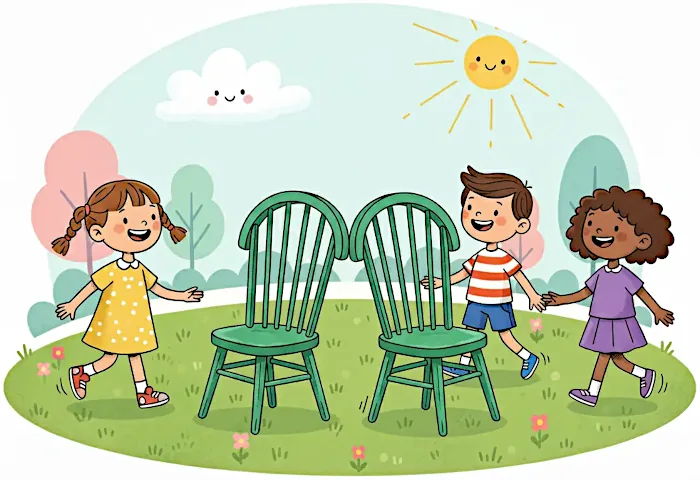
If you have a large group, you can arrange the chairs in two rows with their backs facing each other instead.
Check that all chairs are stable and that the playing area is free from obstacles.
3. Explain the Musical Chairs Rules
Before starting, explain the rules so everyone knows what to do.
The basic rules are:
- Players must move around the chairs while the music is playing.
- Players can walk, dance, or march, depending on the rules chosen by the host.
- When the music stops, everyone must try to sit in an available chair.
- Only one player can occupy each chair.
- The player who does not find a chair is eliminated.
- One chair is removed after each round.
- The remaining players continue until only one person wins.
Remind everyone that pushing, pulling, grabbing, or deliberately blocking other players is not allowed.
4. Start the Music and Move Around the Chairs
Ask all the players to stand around the outside of the circle.
Start the music and let everyone walk or dance around the chairs in the same direction.
The music operator should stop the music at unpredictable intervals. Avoid stopping it at exactly the same time in every round, as players may begin anticipating when it will happen.
The element of surprise is what makes the game exciting.
5. Stop the Music and Find a Seat
When the music stops, everyone must quickly find an available chair and sit down.
The player who remains standing is eliminated from the game.
If two players try to sit on the same chair, the person who is clearly seated first gets the seat. If it is difficult to determine who got there first, the host can use a simple tie-breaker rule.
For younger children, it is better to avoid arguments over close calls and simply restart the round if necessary.
6. Remove One Chair After Each Round
Once the eliminated player has left the playing area, remove one chair.
The number of chairs should always be one fewer than the number of remaining players.
For example:
| Round | Players | Chairs |
|---|---|---|
| Starting round | 10 | 9 |
| Round 2 | 9 | 8 |
| Round 3 | 8 | 7 |
| Round 4 | 7 | 6 |
| Round 5 | 6 | 5 |
| Round 6 | 5 | 4 |
| Round 7 | 4 | 3 |
| Round 8 | 3 | 2 |
| Final round | 2 | 1 |
After removing a chair, make sure the remaining chairs are positioned safely before starting the music again.
7. Continue Until There Is a Winner
Repeat the process until only two players and one chair remain.
Start the music and let the final two contestants circle the chair. When the music stops, both players will compete for the last available seat.
The player who sits down first wins the musical chairs game!
You can celebrate the winner with a small prize, certificate, ribbon, or simply a round of applause.
Musical Chairs Game Variations and Fun Ideas
The traditional game is entertaining on its own, but introducing a few creative variations can make it even more enjoyable.
These ideas are suitable for different ages, party themes, and group sizes.
1. Musical Chairs with Dance Moves
Instead of simply walking around the chairs, ask players to perform different dance moves while the music plays.
For example:
- Dance like a robot.
- Hop like a bunny.
- Walk like a penguin.
- Pretend to be a cowboy.
- Dance with your hands in the air.
When the music stops, everyone must find a seat.
This variation is particularly entertaining at children’s birthday parties because it combines dancing with the excitement of the traditional game.
2. Musical Chairs with Challenges
Place a small challenge card underneath each chair.
When the music stops, players who find a seat must check their cards and complete the challenge written on them.
Challenge ideas include:
- Sing a line from a favorite song.
- Tell a funny joke.
- Name three animals.
- Do five jumping jacks.
- Pretend to be a famous character.
- Say something nice about another player.
You can make the challenges easier for younger children or more entertaining for teenagers and adults.
To keep the game moving, prepare the cards before the party and keep each challenge short.
3. Musical Chairs with Balloons
Add balloons to the game for a colorful birthday party variation.
Place a balloon on each chair. When the music stops, players must find a seat and hold the balloon while sitting down.
For an additional challenge, players can try to keep the balloon in their laps without dropping it.
Avoid requiring players to pop balloons by sitting on them, as this can frighten younger children and create a safety concern.
4. Musical Chairs Team Game
Instead of playing individually, divide everyone into teams of two or more.
Each team must work together to find a seat when the music stops. Depending on the group size, you can require partners to share a chair or arrange the game so that everyone on a team must find a seat.
For a fun challenge, ask two partners to sit on the same chair without either touching the floor with their feet.
Make sure the chairs are sturdy and suitable for the number of people using them.
5. Reverse Musical Chairs
In this version, nobody is eliminated.
Instead of removing a player and a chair after each round, remove one chair but keep all the players in the game.
When the music stops, everyone must work together to fit onto the remaining chairs.
Players can sit on each other’s laps or share seats, provided the chairs are stable and the arrangement is safe.
Continue removing chairs until the group can no longer fit comfortably.
This is a cooperative variation that encourages teamwork rather than competition.
6. Musical Chairs with Themed Music
Choose music that matches the theme of your party.
For example:
- Princess party: Play songs from popular princess movies.
- Superhero party: Use superhero movie soundtracks.
- Disco party: Play classic disco hits.
- Christmas party: Use festive Christmas songs.
- Halloween party: Choose spooky but entertaining music.
You can also ask players to dance in a particular style depending on the song.
7. Musical Chairs with Funny Instructions
Make the game more unpredictable by giving players different instructions while the music plays.
For example, the host might call out:
- Walk like a dinosaur.
- Move in slow motion.
- March like a soldier.
- Dance without moving your feet.
- Walk backward carefully.
- Pretend you are walking on the moon.
When the music stops, everyone must find a seat as usual.
This is a simple way to add humor without changing the basic rules.
8. Musical Chairs with Prizes
Make the game more exciting by offering small prizes to winners.
You could give a prize to the overall winner or introduce small rewards for completing special challenges.
Suitable prizes include:
- Candy or chocolates.
- Stickers.
- Small toys.
- Party favor bags.
- Ribbons or medals.
- Gift cards for older players.
For children’s parties, consider giving small participation prizes to eliminated players so that everyone has something to take home.
How to Adapt the Musical Chairs Game for Different Ages
One of the reasons musical chairs remains popular is that it can be adjusted to suit almost any age group.
However, younger children and older players may enjoy different versions of the game.
Musical Chairs for Toddlers
For toddlers, keep the game simple and relaxed.
Use soft cushions or child-sized chairs, play familiar songs, and allow plenty of space between players.
Rather than eliminating children, consider using a non-competitive version in which everyone gets a seat or receives a small reward.
An adult should supervise the activity throughout.
Musical Chairs for Preschoolers
Preschool children usually enjoy the traditional game, especially when it includes familiar music and funny movements.
Use simple instructions and avoid complicated tie-breaker rules.
You can also introduce dance moves, animal walks, or themed songs to keep the children entertained.
Consider allowing eliminated players to help control the music or cheer for the remaining contestants.
Musical Chairs for School-Age Children
Older children can usually follow the traditional rules and enjoy the competitive element.
Try adding challenge cards, themed music, dance moves, or small prizes.
You can also organize a tournament in which several groups play separate rounds before the winners compete in a final game.
Musical Chairs for Teenagers
Teenagers may enjoy a more energetic version with popular music, funny dance challenges, and unexpected instructions.
You could also introduce themed rounds, such as 1980s music, movie soundtracks, or songs chosen by the players.
For a larger gathering, organize a musical chairs competition with a small prize for the final winner.
Musical Chairs for Adults
Musical chairs is not just for children. Adults can enjoy it at birthday parties, family gatherings, office celebrations, and other social events.
For adults, consider adding music from different decades, trivia challenges, or funny tasks.
You can also introduce a team version or play several short rounds with different music themes.
Keep the rules lighthearted and avoid overly competitive physical challenges.
How to Set Up the Perfect Musical Chairs Game
A little preparation can make a big difference when hosting musical chairs.
Here are some practical tips for creating an enjoyable playing environment.
Choose a Suitable Playing Area
Select an open space where everyone can move comfortably.
A living room, community hall, school gymnasium, or outdoor party area can all work well.
Make sure there is enough room around the chairs and remove anything that could cause players to trip.
Use Suitable Chairs
Choose chairs that are sturdy, stable, and appropriate for the players.
Avoid chairs with wheels, folding chairs that are not properly locked, or lightweight furniture that could tip over easily.
For very young children, consider using floor cushions instead.
Choose the Right Music
Select music that matches the ages and interests of the players.
Songs with clear rhythms work particularly well because players can dance or move along to the beat.
Prepare a playlist in advance so that you do not have to search for songs between rounds.
Assign Someone to Control the Music
Choose someone who is not participating in the game to operate the music.
This person should stop the music at unpredictable intervals and watch carefully to determine whether a player has been eliminated.
Having a dedicated music operator also helps prevent arguments about when the music stopped.
Prepare Small Prizes
A small prize can make the final round more exciting.
You do not need anything expensive. A medal, certificate, chocolate, or small gift is enough to make the winner feel special.
You can also prepare participation treats for everyone else.
Best Music for a Musical Chairs Game
Music plays an important role in making musical chairs entertaining.
The best songs are generally upbeat, recognizable, and easy to dance to. Choose music that is appropriate for the age group and occasion.
Here are some ideas for different types of parties.
| Party Type | Music Ideas |
|---|---|
| Children’s birthday party | Children’s songs and animated movie soundtracks |
| Princess party | Princess movie songs and cheerful pop music |
| Superhero party | Superhero movie soundtracks |
| Teen party | Popular pop and dance songs |
| Adult birthday party | Classic hits from different decades |
| Christmas party | Christmas carols and festive pop songs |
| Halloween party | Spooky soundtracks and Halloween favorites |
| Disco party | Classic disco and dance music |
Tip: Use a playlist with songs of different lengths and tempos. Stop the music at unpredictable moments rather than waiting for the end of a song. This makes every round more exciting.
Safety Tips for Playing Musical Chairs
Although musical chairs is a simple party game, players can become very competitive when trying to find a seat.
A few precautions will help keep everyone safe.
- Use stable chairs: Avoid chairs with wheels or unstable legs.
- Clear the playing area: Remove toys, bags, cables, and other obstacles.
- No pushing or pulling: Players should never shove or trip one another to get a seat.
- Avoid running: Encourage players to walk or dance rather than sprint toward the chairs.
- Allow enough space: Arrange the chairs so players can move around them without bumping into one another.
- Supervise younger children: Have an adult monitor the game, particularly when toddlers or preschoolers are involved.
- Use age-appropriate rules: Consider non-elimination versions for very young children.
- Check the chairs: Make sure they are suitable for the players and cannot easily tip over.
Remember that the goal is to have fun, not to win at any cost.
Games Similar to Musical Chairs
If your guests enjoy musical chairs, you might want to introduce a few other party games that involve music, movement, or quick reactions.
Here are some entertaining alternatives.
1. Freeze Dance
Freeze dance is a simple game in which everyone dances while the music plays.
When the music stops, players must freeze in whatever position they are in.
Anyone who moves after the music stops can be eliminated, or you can simply restart the music and continue playing without eliminating anyone.
2. Musical Statues
Musical statues is similar to freeze dance.
Players dance while the music plays and must stand completely still when it stops.
Anyone who moves, laughs, or loses their balance may be eliminated, depending on the rules.
This game is particularly suitable for younger children.
3. Pass the Parcel
Pass the parcel is a traditional party game in which players pass a wrapped present around a circle while music plays. The present is wrapped in multiple layers of wrapping paper.
When the music stops, the person holding the parcel removes one layer of wrapping.
The game continues until the final layer is removed and the player discovers the prize.
You can include small treats or challenges between the wrapping layers.
4. Musical Bumps
Musical bumps is another music-based party game.
Players dance or move around while music plays. When it stops, everyone must sit on the floor as quickly as possible.
The last player to sit down is eliminated.
Unlike musical chairs, this game does not require any chairs.
5. Limbo
Limbo is a fun party game in which players take turns bending backward to pass underneath a horizontal bar.
After each round, the bar is lowered, making it increasingly difficult to get underneath without touching it or falling.
The last player who successfully passes underneath the bar wins.
6. Hot Potato
Hot potato is a quick and entertaining game that uses music and a soft ball or similar object.
Players sit or stand in a circle and pass the object from one person to another while music plays.
When the music stops, the person holding the object is eliminated or must complete a funny challenge.
The game continues until one player remains.
Musical Chairs Game FAQ
Here are answers to some frequently asked questions about the musical chairs game, including its rules, equipment, variations, and suitability for different ages.
What are the rules of the musical chairs game?
Players walk or dance around a circle of chairs while music plays. When the music stops, everyone must find a seat. The player left standing is eliminated, and one chair is removed. The game continues until the last round where only two players and one chair remain. The person who sits in the final chair wins.
How many chairs do you need for musical chairs?
You need one fewer chair than the number of players. For example, if 12 people are playing, you need 11 chairs. One chair is removed after each round as players are eliminated.
How many players do you need for a musical chairs game?
You need at least three players for the traditional version, although the game is generally more entertaining with larger groups. Groups of 6 to 20 players work well for most birthday parties and family gatherings.
What age is musical chairs suitable for?
Musical chairs can be adapted for almost any age group. Toddlers and preschoolers can play gentler versions using cushions and non-elimination rules, while older children, teenagers, and adults can enjoy the traditional competitive version.
How do you win musical chairs?
To win, you must find a chair and sit down every time the music stops. Continue surviving each round until only one chair and two players remain. The player who gets the final chair wins.
Can you play musical chairs without music?
Yes. Although music is a traditional part of the game, you can use another signal to start and stop each round. For example, a host can clap their hands, ring a bell, or call out a command. However, using music generally makes the game more entertaining.
What happens if two people sit on the same chair?
The player who clearly sits down first gets the chair. If it is impossible to determine who arrived first, the host can restart the round or use a simple tie-breaker. Agree on how ties will be handled before the game begins.
Can you play musical chairs with a small group?
Yes. You can play with three or more people using one fewer chair than the number of players. Smaller groups can still enjoy the game, although it may be over more quickly.
What is the reverse musical chairs game?
Reverse musical chairs is a cooperative variation in which players are not eliminated. Instead, one chair is removed after each round, and everyone must work together to fit onto the remaining chairs when the music stops.
What type of music is best for musical chairs?
Upbeat songs with clear rhythms are ideal. Children’s music, pop songs, dance hits, movie soundtracks, and classic party songs are all suitable choices. Select music that matches the age group and theme of your party.
How long does a musical chairs game last?
The length depends on the number of players and how long each round takes. A small group may finish in a few minutes, while a larger group can take 10 to 15 minutes or longer. You can also play multiple games with different music or rules.
What are some fun prizes for musical chairs winners?
Suitable prizes include small toys, candy, chocolates, stickers, medals, ribbons, gift cards, and party favor bags. For children’s parties, you can also give small participation prizes to eliminated players.
Can musical chairs be played outdoors?
Yes. Musical chairs works well outdoors in gardens, parks, and other open spaces. Choose a level, non-slippery surface and use stable chairs that will not tip over easily. Make sure the music can be heard clearly by everyone.
What are some alternatives to musical chairs?
Popular alternatives include freeze dance, musical statues, musical bumps, pass the parcel, hot potato, and limbo. These games also involve music, movement, or quick reactions and are suitable for many types of parties.
How can you make musical chairs more fun?
You can make the game more entertaining by introducing dance moves, themed music, funny instructions, challenge cards, balloons, team rounds, or small prizes. Changing the rules slightly for each game also helps keep players interested.
Conclusion
The musical chairs game is a simple yet entertaining party activity that has remained popular with children and adults alike. Its easy rules, minimal equipment requirements, and exciting competition make it a great choice for birthday parties, school events, family gatherings, and other celebrations.
You can stick with the traditional version or introduce creative variations such as dance challenges, team games, themed music, and reverse musical chairs.
With a little preparation, a good playlist, and a suitable playing area, you can turn this classic party game into an enjoyable activity that gets everyone laughing and involved.
Whether you’re organizing a children’s birthday party or looking for an entertaining activity for adults, musical chairs is a fun way to bring people together.