
Pin the Tail on the Donkey is a classic birthday party game that brings laughter, friendly competition, and plenty of memorable moments to a celebration. It is easy to organize, requires only a few inexpensive materials, and can be adapted for children of different ages.
How to Play Pin the Tail on the Donkey
The aim of the game is simple: players take turns trying to attach a donkey’s tail to the correct spot on a picture of a donkey while blindfolded. Without being able to see where they are placing the tail, players often end up attaching it in unexpected places, making the game entertaining for everyone watching.
This traditional party game is particularly popular at children’s birthday parties, but older children, teenagers, and adults can enjoy it too. With a few creative changes, you can even adapt the game to match your birthday party theme.
In this guide, you will learn how to play Pin the Tail on the Donkey, what materials you need, how to set up the game, how to choose a winner, and how to create fun variations for different celebrations.
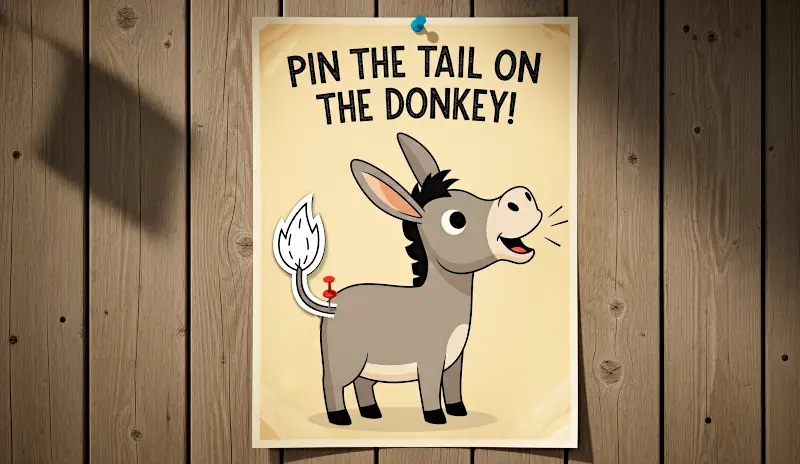
What You Need to Play Pin the Tail on the Donkey
One of the best things about Pin the Tail on the Donkey is that you do not need much equipment. You can use a ready-made game poster or make your own version using paper and basic craft supplies.
Gather the following materials before the party:
| Item | Purpose |
|---|---|
| Large donkey poster | Provides the picture onto which players must attach the tail. |
| Paper or card tails | Gives each player a tail to place on the donkey. |
| Blindfold | Prevents players from seeing where they are placing the tail. |
| Double-sided tape, reusable sticky tack, or hook-and-loop dots | Holds each tail in place without using sharp pins. |
| Pen or marker | Helps identify each player’s tail and record the results. |
| Wall, door, or sturdy display board | Provides a suitable surface for displaying the poster. |
| Scoring sheet (optional) | Helps track the results when several people are playing. |
| Small prizes (optional) | Adds an extra incentive for friendly competition. |
For a homemade game, you can draw a donkey on a large sheet of paper or print an image and attach it to cardboard. Cut out one tail for every player, and put a small piece of reusable adhesive on the back of each tail.
Write each player’s name or initials on their tail before the game begins. This makes it easier to identify the pieces when several tails end up close together.
Safety tip: Use adhesive rather than sharp pins, particularly when young children are playing. Make sure the poster and playing area are secure before the game starts.
How to Set Up Pin the Tail on the Donkey
A little preparation makes the game easier to manage and more enjoyable for everyone. Follow these steps before your guests begin playing.
1. Hang the donkey poster
Choose a flat wall, door, or sturdy display board in an area with enough room for players to approach the picture safely.
Attach the donkey poster at a suitable height for the age group playing. If the participants are young children, position the picture low enough for them to reach it comfortably.
If you are playing outdoors, attach the poster securely to a firm board or easel. Avoid placing it where wind could blow it over or where uneven ground might cause players to trip.
2. Prepare the tails
Cut out a paper tail for each player. You can use plain white paper, colored cardstock, or construction paper.
Make the tails large enough to handle easily, especially for younger children. Attach a small piece of double-sided tape, reusable sticky tack, or hook-and-loop material to the back of each tail.
Write each player’s name on their tail. If you want to make the game more colorful, decorate the tails with markers, patterns, or stickers before the party starts.
3. Mark the target
Identify the correct position for the donkey’s tail. You can mark the target on the poster with a small dot or use a separate reference image to establish the correct location.
Keep the target hidden from blindfolded players. The host should know where the tail belongs so that the results can be judged fairly.
For younger children, you may want to make the target area slightly larger to make the game less challenging.
4. Prepare the playing area
Remove chairs, toys, bags, and other obstacles from the space between the starting point and the poster.
Make sure the floor is not slippery and that players have a clear route to the donkey. Keep other guests far enough away that blindfolded players will not bump into them.
If the party is being held in a small room, allow players to take turns rather than trying to play simultaneously.
5. Explain the rules
Before starting, explain that each player will have one turn to place a tail on the donkey while unable to see the picture.
Show everyone how the adhesive works and explain where they should start. Let younger players know that they can ask for help if they feel uncomfortable wearing the blindfold.
Once everyone understands the rules, you are ready to begin.
How to Play Pin the Tail on the Donkey
The game is straightforward, and a host can usually explain the rules in just a minute or two.
Follow these steps to play.
Step 1: Choose the first player
Select a player to begin. You can start with the birthday child, draw names from a bowl, or simply work around the room.
Give the player their labeled tail and make sure the adhesive is ready to use.
Step 2: Put on the blindfold
Place the blindfold over the player’s eyes so that they cannot see the donkey poster.
Check that the blindfold is comfortable and does not cause distress. Players who do not want to wear one can participate with their eyes closed or choose a different role, such as keeping score.
Step 3: Turn the player around gently
For players who are comfortable doing so, gently turn them around once or twice to make it harder to remember the direction of the poster.
Spinning is optional. Avoid spinning young children or anyone who might become dizzy or lose their balance. You can make the game challenging simply by asking players to start from a short distance away.
Step 4: Guide the player to the poster
Ask the player to walk slowly toward the donkey poster while keeping the blindfold on.
A host should remain nearby to prevent collisions and help the player stay within the safe playing area. If necessary, give simple verbal directions such as “take two steps forward” or “reach out carefully.”
Other guests can cheer, laugh, and encourage the player, but avoid pushing, pulling, or deliberately leading them into obstacles.
Step 5: Pin the tail on the donkey
Once the player reaches the poster, let that player decide where to place the tail.
The player should attach it to the poster using the prepared adhesive. Each player gets one attempt unless you decide to use a variation that allows additional tries.
After the tail is attached, remove the blindfold and let the player see the result. This is often the funniest moment of the game.
Step 6: Record the result
Write down the player’s name or make sure the player’s tail is clearly labeled.
If you are playing a simple version, you can leave each tail where it was placed until everyone has taken a turn. This creates a funny picture of all the attempts and makes the final result easy to compare.
For a more competitive game, record how far each tail is from the correct target.
Step 7: Let everyone take a turn
Continue until every player has had a chance to pin the tail on the donkey.
Encourage everyone to cheer for one another. The game works best when the focus is on having fun rather than getting every tail in exactly the right place.
Step 8: Choose the winner
Once everyone has played, compare the positions of the tails.
The player whose tail is closest to the correct target wins. You can award a small prize, a ribbon, a certificate, or simply the title of champion.
For a less competitive party, celebrate the funniest or most unexpected attempts as well.
Rules for Pin the Tail on the Donkey
If you want to keep the game fair and easy to follow, use these basic rules:
- Each player gets one tail and one turn.
- Players must keep the blindfold on while placing the tail.
- The host may guide players verbally to help them stay safe, but should not tell them exactly where to place the tail.
- Players must walk rather than run while blindfolded.
- Once a tail has been placed, it cannot be moved.
- The host determines the winner by comparing each tail’s position with the target.
- Everyone should respect other players and avoid distracting them in ways that could make the game unsafe.
You can change these rules to suit the age group and the style of party. For example, very young children may need help attaching their tails, while older children and adults may enjoy a more challenging version.
How to Score Pin the Tail on the Donkey
The easiest way to judge the game is to choose the tail that lands closest to the correct spot. However, if several tails are close together, a simple scoring system can help.
Option 1: Closest tail wins
This is the traditional approach. After everyone has played, compare the position of each tail with the target.
The player whose tail is closest to the target wins. You can judge by eye or measure the distance between the center of each tail and the target point.
Option 2: Award points for accuracy
For a more competitive game, award points as follows, based on how close each tail is to the target.
| Result | Points |
|---|---|
| Closest tail | 5 |
| Second closest | 3 |
| Third closest | 2 |
| Other attempts | 1 |
Add up the points after all players have taken their turns if you are running several rounds. The player with the highest total wins.
Option 3: Give out fun awards
Not every birthday party needs a single winner. You can recognize different achievements to make the game enjoyable for everyone.
Some ideas include:
- Closest to the Target: For the most accurate placement.
- Funniest Attempt: For the most entertaining result.
- Most Creative Placement: For an especially unexpected tail position.
- Best Sport: For the player who cheered everyone on.
- Best Teamwork: For a team that encouraged one another.
These awards work particularly well at parties with younger children, where the main goal is to encourage participation rather than emphasize winning.
Creative Pin the Tail on the Donkey Variations
One reason this game remains popular is that the basic idea can be adapted to suit almost any birthday party theme. Instead of a donkey, use a picture of a character, animal, or object that matches the celebration.
Players follow the same basic rules but attach a different item to the picture. Here are some variations to try.
| Party theme | Game variation | What players must pin |
|---|---|---|
| Princess party | Pin the Crown on the Princess | A crown on the princess’s head |
| Mermaid party | Pin the Tail on the Mermaid | A tail on the mermaid |
| Unicorn party | Pin the Horn on the Unicorn | A horn on the unicorn’s forehead |
| Barbie-themed party | Pin the Bow on the Doll | A bow on the doll’s hair |
| Dinosaur party | Pin the Tail on the Dinosaur | A tail on the dinosaur |
| Pirate party | Pin the Patch on the Pirate | An eye patch over the pirate’s eye |
| Superhero party | Pin the Emblem on the Hero | An emblem on the superhero’s chest |
| Farm-themed party | Pin the Spot on the Cow | A spot on the cow |
| Space party | Pin the Planet in Space | A planet in a designated part of the picture |
| Under-the-sea party | Pin the Fin on the Fish | A fin on the fish |
| Monster party | Pin the Eye on the Monster | An eye in the correct position |
| Sports party | Pin the Ball on the Goal | A ball inside the goal |
Choose a variation that fits the interests of the birthday child. For example, a dinosaur version may be ideal for a dinosaur-themed party, while a crown or unicorn version may suit a princess-themed celebration.
You can also create a completely original game based on the birthday child’s favorite animal, hobby, or fictional character.
How to Make Your Own Pin the Tail on the Donkey Game
Making your own version is a simple craft project that can save money and help you personalize the activity.
You do not need professional drawing skills. A basic illustration with a clearly defined target is enough.
Materials
You will need:
- Large sheets of paper or poster board
- Colored pencils, crayons, or markers
- Scissors
- Cardstock for the tails
- Reusable adhesive or hook-and-loop dots
- Tape for attaching the poster to a wall or board
Instructions
- Draw the donkey. Draw a large donkey on poster board, leaving enough space around its body for players to reach the tail area.
- Color the picture. Use bright colors to make the poster attractive. Children can help decorate it before the party.
- Mark the target. Decide where the tail should go and make a small reference mark that the players cannot see.
- Cut out the tails. Make one tail for each player, using the same general size and shape.
- Add the adhesive. Attach a small piece of reusable adhesive to the back of each tail.
- Label the pieces. Write each player’s name on their tail to make scoring easier.
- Display the poster. Attach the finished picture to a suitable wall or board and check that everything is secure.
For a themed party, replace the donkey with another drawing and change the pieces accordingly. You can prepare the game in advance or turn it into a pre-party craft activity.
If you plan to reuse the game, mount the poster on sturdy cardboard and store the tails in an envelope when the party is over.
Tips for Making Pin the Tail on the Donkey More Fun
A few small changes can make the game more engaging and help it run smoothly.
Adapt the difficulty to the players
Younger children may find the game difficult if the target is too small or the starting point is too far away. Make the target area larger, shorten the distance, and let them play without spinning.
Older children and adults may enjoy a smaller target or a longer starting distance. Keep the game fair by using the same rules for everyone in the same round.
Let children decorate their own tails
Set out markers, crayons, and stickers before the game starts. Give each child a tail to decorate with their name, favorite colors, or a creative design.
This activity keeps guests occupied while the host prepares the game and gives everyone a personalized piece to use.
Add music
Play cheerful background music while guests take turns. You can lower the volume when the player approaches the poster so that the host’s instructions remain easy to hear.
Music can also help build anticipation before the blindfold comes off and everyone sees where the tail landed.
Offer small prizes
Prizes are optional, but they can make the game feel like a special part of the birthday celebration.
Stickers, paper medals, small certificates, or themed party favors are suitable options. You can also let the winner choose the next game or help the host run the next round.
Take photos
With the player’s permission, take photos of the funny results after each turn. These pictures can become part of the birthday album and help preserve memories of the celebration.
Avoid distracting players with cameras while they are moving blindfolded. Safety and participation should come first.
Keep the game moving
Explain the rules before the first turn, prepare all the tails in advance, and keep the playing area clear.
If you have a large group, ask a helper to organize the queue and record the scores. This prevents long waits and makes the game easier to manage.
Safety Tips for Pin the Tail on the Donkey
Because players cannot see while wearing a blindfold, it is important to prepare the playing area carefully.
Follow these precautions:
- Clear the floor: Remove toys, loose cables, bags, and furniture that could cause someone to trip.
- Use safe adhesives: Choose tape, reusable sticky tack, or hook-and-loop dots instead of sharp pins or needles.
- Avoid excessive spinning: Turning around is optional. Do not spin children repeatedly, and skip this step if anyone feels dizzy or unsteady.
- Supervise young children: Have an adult stay close enough to help players move safely.
- Keep the route clear: Allow only one blindfolded player in the playing area at a time.
- Use a stable poster: Make sure the picture and any supporting board cannot fall over.
- Respect personal preferences: Never force children to wear a blindfold or take part in a game that makes them uncomfortable.
For any players that do not want to be blindfolded, let them close their eyes, play with a light covering over their eyes if they are comfortable with it, or participate as a scorekeeper or judge.
The game should be enjoyable for everyone, so adapt the rules whenever necessary.
Pin the Tail on the Donkey for Different Age Groups
The game can be adapted for a wide range of ages. A few adjustments will help make it enjoyable for everyone at the party.
| Age group | Suggested adjustments |
|---|---|
| Toddlers and preschoolers | Use a large target, keep the starting distance short, skip spinning, and offer adult assistance. |
| Children ages 5 to 8 | Use standard rules, provide simple instructions, and allow a little extra time for each turn. |
| Older children | Introduce themed variations, smaller targets, or a team tournament. |
| Teenagers | Use funny or personalized pictures and creative challenges to keep the game entertaining. |
| Adults | Try nostalgic versions, humorous themes, or a friendly competition with optional prizes. |
| Mixed-age groups | Adjust the difficulty for younger participants and use team play so everyone can contribute. |
For mixed-age parties, consider pairing younger children with older children or adults. Older participants can help organize the game, keep score, and encourage the younger players without choosing where they should place their tails.
Hosting a Pin the Tail on the Donkey Tournament
If you have a large group or want the game to last longer, turn it into a friendly tournament.
A tournament adds extra rounds and gives players another chance to improve their scores.
How to organize the tournament
- Divide the guests into teams. Create small teams with a mixture of ages if appropriate.
- Give everyone a turn. Each team member takes a turn placing their tail on the donkey.
- Record the results. Measure the distance from each tail to the target or award points according to your chosen scoring system.
- Play additional rounds. For a longer game, use a different poster or themed variation in each round.
- Add the team scores. Combine the points earned by all team members.
- Announce the winners. The team with the highest total score wins.
You could use a simple point system, such as five points for the closest tail, three points for second place, and one point for participation. Decide how ties will be handled before the tournament begins.
A homemade trophy, paper medals, or a certificate can make the winning team feel special without requiring expensive prizes.
For younger children, keep the tournament short and focus on participation. For older children and adults, multiple rounds can add a little more competition.
How Long Does Pin the Tail on the Donkey Take?
Pin the Tail on the Donkey is a short party activity that is easy to fit into a birthday schedule.
The exact time depends on the number of players, how long each turn takes, and whether you include multiple rounds. Below is an estimate of the time a game takes, depending on the number of players.
| Number of players | Estimated playing time |
|---|---|
| 4 to 6 players | 5 to 10 minutes |
| 8 to 10 players | 10 to 15 minutes |
| 12 to 15 players | 15 to 20 minutes |
| 16 to 20 players | 20 to 30 minutes |
These estimates allow a little time for explaining the rules, putting on the blindfold, and revealing each result. A tournament or a version with extra challenges will take longer.
If you are planning a birthday party with several activities, Pin the Tail on the Donkey works well as a short game between other events.
Frequently Asked Questions About Pin the Tail on the Donkey
What age is Pin the Tail on the Donkey suitable for?
The game is generally suitable for preschool-aged children and older, provided the rules are adapted to their abilities. Younger children may need adult assistance and should not be spun around repeatedly.
Older children, teenagers, and adults can also enjoy the game, especially when themed variations or extra challenges are introduced.
Can adults play Pin the Tail on the Donkey?
Yes. Although it is commonly associated with children’s birthday parties, the game can be entertaining for adults too.
For an adult birthday party, you could use humorous illustrations, personalized targets, or a team tournament. Keeping the rules simple helps everyone join in, regardless of experience.
How many people can play?
There is no strict limit to the number of participants. The game is played one person at a time, so the main consideration is how long you want the activity to last.
Prepare one labeled tail for each player and allow enough time for everyone to take a turn. For larger groups, a tournament or team format can help keep everyone involved.
Where can I get a Pin the Tail on the Donkey printable?
You can create your own printable by drawing a donkey or preparing a digital illustration and printing it on paper or cardstock. You can also look for printable game templates from websites that offer party activities and craft resources.
Make sure you have permission to print and use any downloaded design, particularly if you plan to distribute copies or use it commercially.
What can I use if I do not have a wall?
You can attach the poster to a door, a sturdy display board, or an easel. The important thing is to use a stable surface that will not fall over when players approach it. Avoid placing the poster on furniture that could tip or move unexpectedly.
Can I play without a blindfold?
Yes. If someone does not want to wear a blindfold, they can close their eyes or choose another role in the game.
You can also create a modified version in which players stand farther away and try to place the tail without measuring the distance first. The rules can be adjusted to make the game comfortable for everyone.
What can I use instead of a donkey?
You can replace the donkey with almost any character, animal, or object that suits your party theme.
Popular options include a princess, unicorn, mermaid, dinosaur, pirate, superhero, or monster. The item players attach should match the picture, such as a crown, horn, tail, patch, or emblem.
How do you decide who wins?
The winner is usually the player whose tail lands closest to the correct target.
If several tails are close together, measure the distance from the center of each tail to the target point. Alternatively, award points for the closest placements or give out fun awards for different achievements.
How can I make the game easier for younger children?
Use a larger target, reduce the starting distance, and skip spinning. Make sure the poster is at a comfortable height and allow an adult to assist when needed.
You can also make the game less competitive by celebrating every attempt rather than focusing on a single winner.
How can I make the game more challenging?
For older children and adults, use a smaller target, increase the starting distance, or introduce additional themed rounds.
You can also organize a tournament with a scoring system. Avoid changes that could make blindfolded players lose their balance or collide with other guests.
Make Pin the Tail on the Donkey Part of a Memorable Birthday Party
Pin the Tail on the Donkey is a simple, affordable, and entertaining birthday party game that can bring guests together for plenty of laughter. With a poster, a few paper tails, and a safe place to play, you can organize the activity without complicated preparation or expensive equipment.
The classic version is a great choice for children’s birthday parties, but themed variations, team tournaments, and creative scoring options make it suitable for many other celebrations too.
Prepare the materials in advance, explain the rules clearly, and adapt the game to suit the ages and preferences of your guests. Most importantly, keep the atmosphere friendly and make sure everyone feels comfortable taking part.
With these simple ideas, Pin the Tail on the Donkey can become a fun and memorable part of your next birthday celebration.